


Reading Strategies for Special Education Students
 Amanda Unrau
 M.A. CCC-SLP
06/01/26 | Last modified: 07/08/26
Reading challenges affect millions of children. In the 2022–23 school year, 7.5 million U.S. students received special education services, accounting for roughly 1 in every 7 public school students.
Many of these students experience reading difficulties that can affect decoding, fluency, comprehension, and confidence in the classroom.
These numbers have continued to rise. Learning to read can be more complex for students in special education because they struggle with many of the components involved in reading. Implementing the right strategies with these students can make a big difference. This article will cover effective reading strategies to support these students.
What Are Reading Difficulties in Special Education Students?
Children who receive special education services often do not acquire the foundational skills necessary to develop reading skills. For example, children with dyslexia have weak phonological awareness skills, which is a key component of reading.
These challenges can show up in different ways, and understanding the types of reading difficulties can help clarify whether a student mainly struggles with decoding, fluency, comprehension, or a combination of skills.
A comprehensive reading assessment will show where the underlying difficulty lies. These special education students may skip words, have difficulty remembering letter sounds or sight words, or avoid reading tasks.
Why Specialized Reading Strategies Matter
A one-size-fits-all approach does not work when helping special education students learn to read. Reading strategies for students with learning disabilities should be individualized.
Each child will have unique strengths and weaknesses that need to be taken into consideration.
Many children will benefit from a variety of approaches. Students in special education often need explicit, structured reading support.

Reading Strategies for Special Education Students
Many reading strategies are available for special education students. We have compiled a list of strategies, including explicit instruction, multisensory approaches, reading comprehension techniques, motivational considerations, and classroom strategies.
Explicit and Structured Instruction Strategies
- Direct instruction: Direct instruction is one of the most effective special education reading strategies. Using direct instruction, reading skills are explicitly taught. The main methods of instruction include drill, repetition, and practice. Direct instruction can be delivered individually or to small groups.
- Structured literacy: This systematic and sequential instructional approach targets five key pillars of reading instruction: phonemic awareness, phonics, fluency, vocabulary, and comprehension. It includes teacher-assisted and independent practice with continual reinforcement. Progress is monitored, and changes are made to better meet the needs of all children. The goal is for children to learn the skills they need to be good readers in an efficient timeframe without any gaps.
- Repetition: Children learn to read by practicing reading. They need to practice reading over and over. Repeated reading improves word reading, reading fluency, and reading comprehension. For children with low reading levels, use short texts, and have them reread the same passage three times before moving on to another text. When a child improves on one text, those skills often carry over to the next text.
- Modeled reading: Children can improve their own reading skills when they follow along while listening to skilled readers. During modeled reading, an adult reads aloud while the child follows along with the text. This approach works because it allows children to hear accurate pronunciation of words as well as appropriate pacing and prosody, and they are actively engaged.
Multisensory Reading Strategies
- Combine visual, auditory, and tactile activities: Our brains crave movement and sensory input. Add in sound, sight, and touch to regulate a child’s nervous system while reducing frustration. When children experience sounds and letters instead of just memorizing them, they feel, hear, and see words and letters in their mind, which helps to improve learning.
- Write and trace letters: To add some play to reading instruction, have your child trace letters in sand, salt, or shaving cream while they say the sounds out loud. This added texture boosts memory. Use sweeping arm motions to skywrite words. This body awareness improves focus.
- Letter-sound hopscotch: Using a hopscotch grid on the floor or outside, write letters in the squares instead of numbers. Call out a letter sound, and have the child jump on the letter that matches that sound.
- Finger tapping: This activity helps children improve their phonemic awareness skills by breaking words into individual phonemes. Show the child a written word, and have them tap a different finger on their hand for each sound in the word.
Reading Comprehension Strategies
- Strategy instruction: Strategy instruction involves teaching children a strategy that they can generalize to other reading tasks once it is learned. This is one of the necessary components of effective reading comprehension strategies for students with learning disabilities. For example, you can teach a child to look for patterns in words, identify relevant context clues, or determine the main idea in a passage. They can then use these strategies in anything they read.
- Use graphic organizers: Graphic organizers help children visually represent story components. They can come in many forms, including Venn diagrams, flow charts, word webs, story maps, and others. Graphic organizers can aid in comprehension because they provide guidance for identifying, organizing, and remembering key concepts.
- K-W-L: KWL stands for What I Know, What I Want to Learn, and What Have I Learned. This strategy teaches children to do what good readers do by activating their background knowledge and setting goals for their reading. When children identify what they know, they connect what they learn while reading to prior knowledge. They learn to determine the purpose for their reading by choosing what they want to learn. This also helps them monitor their comprehension. Children begin to understand what they know and don’t know by putting things in their own words as they identify what they learned.
- Directed Reading and Thinking Activity (DRTA): The goal of DRTA is for children to learn to make predictions by using reading as a thinking process. Before children start reading, the parent or teacher asks the child to identify a purpose for reading and make predictions about what they will read. While the child reads, the adult stops the child at certain points to have them make more predictions and change their purpose and predictions if they want to. After the child finishes reading, the child locates and reads aloud portions of the text that back up their predictions and explains their reasoning.
- Think-Alouds: With the think-aloud strategy, teachers or parents verbalize out loud while reading a passage orally. While the adult reads, they share their thoughts, ideas, predictions, questions, inferences, and reflections. They model how a skilled reader gathers meaning from a text. This shows students how to engage with text and monitor their own comprehension.
Engagement and Motivation Strategies
- Build a growth mindset: Children who struggle to read often become discouraged and lack confidence. We can help them regulate their brain so that they can learn by helping to rewrite their thoughts about themselves. Encourage your child by responding calmly, celebrating their effort and small wins, and reminding them that they are still learning. Since children mirror your nervous system and energy, remain calm and positive.
- Roundtable: With the roundtable strategy, small groups of children sit in a circle and discuss a text. This gives them an opportunity to discuss what they found interesting, what was confusing, and what bothered them about what they just read.
- Book clubs for kids: A children’s book club emphasizes the social-emotional component of reading. When a child can discuss a series they enjoy or characters that they relate to with their peers, they connect with reading in a new way. The key is to let the children lead and not make the club too structured like school.
Classroom and Environmental Strategies
- Keep sessions short: Long sessions of reading instruction can be discouraging and remind children how difficult reading is for them and how much they can’t do. Instead, keep sessions at 10 to 15 minutes. These shorter periods of time are more conducive to attention and engagement, and can reduce frustration.
- Reduce distractions: Set up a cozy area at home or in the classroom for reading practice. Provide comfortable seating and pillows, fun lighting, and headphones. Your child will love having a reading corner just for them. They can wear headphones to block out any noise in the area.
- Create structured routines: Set up a schedule so the expectations are clear up front. You could plan to practice a strategy for 10 minutes in the morning and another 10 minutes in the afternoon. Set aside a time where you and your child read together every day. You may have to adjust the schedule as you find out what works best, but a solid routine ensures that you both will stick to it.
- Provide visual aids: Incorporating visuals keeps things interesting and helps students focus. Provide highlighters for your child to highlight unknown words or sections they want to come back to. Wikki Stix, which are bendable, wax-coated yarn sticks, can be used to underline lines in a text as the child reads. Offer access to a tablet or phone so they can look up pictures of unfamiliar vocabulary.
How to Choose the Right Reading Strategies
The best way to help a child with reading difficulties is to choose support that matches their individual strengths, weaknesses, and reading profile. Determine your child’s baseline, what skills they are lacking, and areas in which they excel. If your child has difficulty understanding what they read, include a strategy for comprehension. If they lack focus or motivation, include strategies that limit distractions and provide encouragement.
Keep in mind the learning style and personality of your child. Some children need more movement or benefit from multisensory approaches. Some children require adult prompts and guidance, while others are more independent.
On top of that, any strategy chosen should be adapted to each child. Each child learns at their own rhythm. Some children will race through a program and others will need more time. Consider the difficulty level of the reading material you provide; it should be individualized to each child.
Common Mistakes to Avoid
When choosing and implementing reading strategies for special education students, be sure to avoid these common mistakes.
- Using the same method for all students: As stated above, each child has a unique learning profile and unique strengths and weaknesses. Students with similar profiles may be able to be grouped together in small groups, but they still each have individual needs that must be considered and addressed.
- Lack of consistency: Implementing reading strategies for students with learning disabilities is not something that is done just once a week. Children get better at reading through practice. They need a lot of repetition, so be consistent.
- Overloading students with too many strategies: Most children will benefit from using more than one strategy, but that doesn’t mean they need to try them all at once. Be careful not to overwhelm them. Some children may need to focus on one or two strategies at a time before adding a new one.
The Benefits of Using Forbrain for Reading Support
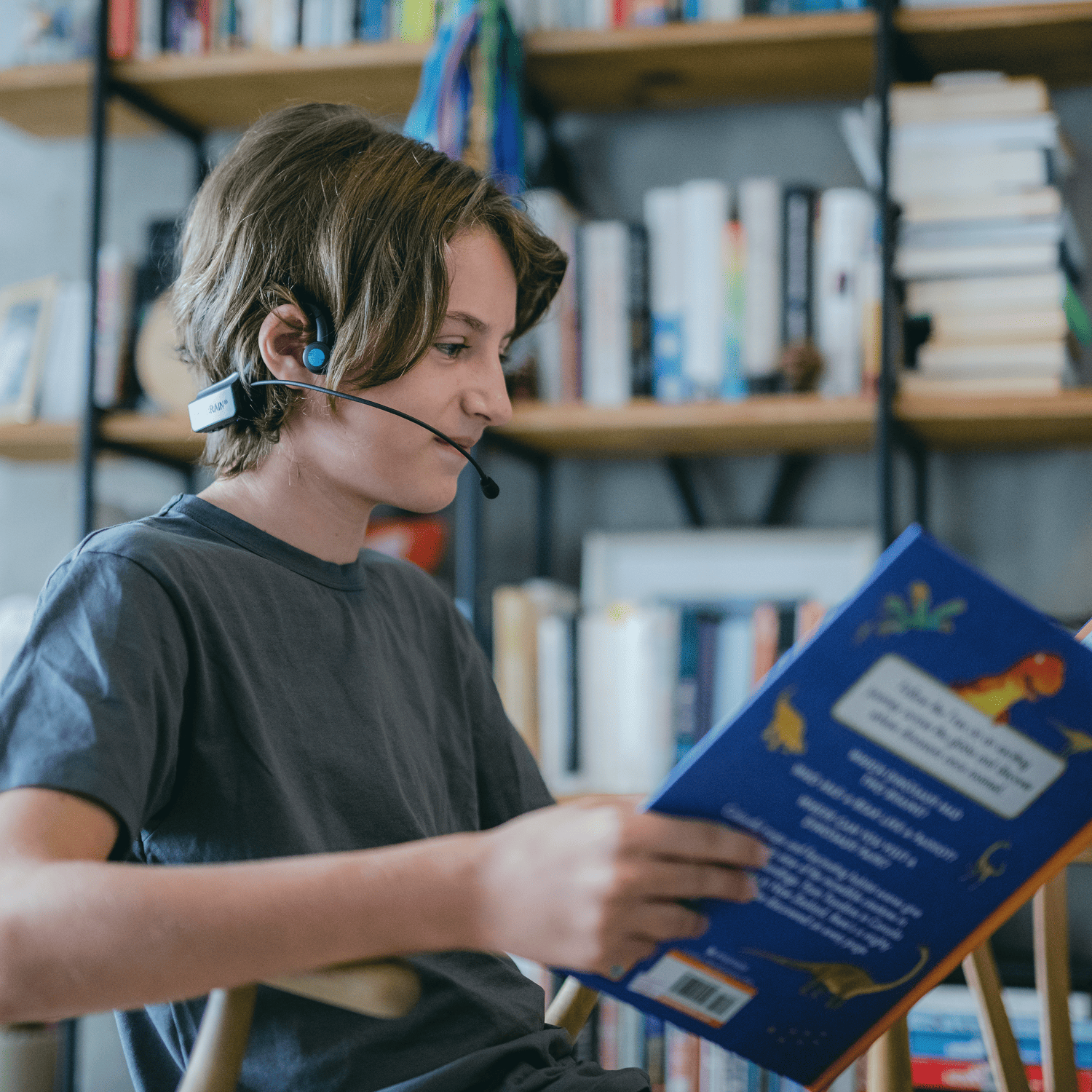
Forbrain is an auditory stimulation tool that can offer reading support to special education students. Worn as a headset, it helps users hear their own voice more clearly.
This helps to improve auditory attention, which is necessary for auditory processing. It limits background noise, which improves focus. The loop between speaking and listening is strengthened, which can improve speech articulation over time as the brain recognizes differences in speech sounds.
Some educators and parents use it as a supplementary tool alongside evidence-based reading instruction. However, it should not replace structured literacy interventions or direct reading instruction.
Bottom Line
Students in special education often have difficulty learning to read. These children can become skilled readers, but they require structured support. There are many reading strategies in this article, but no single strategy will work for all children. Determine the unique needs of your child, and make sure to individualize any strategies you choose. Offer tailored support in a consistent routine. Be sure to celebrate small wins to increase engagement and motivation.
References
Dr. Capanna-Hodge, Roseann. (2026, May 15). Teaching Reading to Students with Learning Disabilities. Dr. Roseann. https://drroseann.com/post/how-to-teach-reading-to-students-with-learning-disabilities
Loewus, Liana. (Accessed 2026, May 27). What is Structured Literacy? Reading Universe. https://readinguniverse.org/article/explore-teaching-topics/features-of-structured-literacy-instruction/what-is-structured-literacy
L is for Literacy. (2025, April 1). Modeled Reading: Your Secret Weapon for Building Fluent Readers. L is for Literacy. https://lisforliteracy.com/modeled-reading/
Psychology Town. (2025, October 26). Effective Reading Interventions for Specific Learning Disabilities. Psychology Town. https://psychology.town/mental-health-in-special-areas/effective-reading-interventions-learning-disabilities/
Reading Rockets. (Accessed 2026, May 24). Reading Methods for Students with LD. Reading Rockets. https://www.readingrockets.org/topics/learning-disabilities/articles/reading-methods-students-ld
Reading Rockets. (Accessed 2026, May 28). Reading Motivation. Reading Rockets. https://www.readingrockets.org/reading-101/reading-motivation
Reading Rockets. (Accessed 2026, May 27). Think-Alouds. Reading Rockets. https://www.readingrockets.org/classroom/classroom-strategies/think-alouds
Richland, Karina. (2026, January 29). 9 Effective Multisensory Reading Activities. Pride Reading Program. https://pridereadingprogram.com/multisensory-reading-ideas/
Shanahan, Timothy. (2017, August 4). Everything You Wanted to Know About Repeated Reading. Reading Rockets. https://www.readingrockets.org/blogs/shanahan-on-literacy/everything-you-wanted-know-about-repeated-reading
Stanberry, Kristin, & Swanson, Lee. (Accessed 2026, May 26). Effective Reading Interventions for Kids with Learning Disabilities. Reading Rockets. https://www.readingrockets.org/topics/dyslexia/articles/effective-reading-interventions-kids-learning-disabilities
Texas Education Agency. (Accessed 2026, May 26). Strategies that Promote Comprehension. Reading Rockets. https://www.readingrockets.org/topics/background-knowledge/articles/strategies-promote-comprehension
The ASHA Leader Live. (2020, May 6). Number of Special Education Students Continues to Rise. The ASHA Leader Live. https://leader.pubs.asha.org/do/10.1044/leader.NIB1.25052020.10/full/