


Types of Stuttering by Cause, Onset, and How It Sounds
 Amanda Unrau
M.A., CCC-SLP
11/11/26 | Last modified: 11/20/26
If you or your child stutters, you have likely heard that there are different types of stuttering. You may be wondering which type of stuttering applies to you or your child. Knowing the type of stuttering you or your child experiences helps guide the right treatment and support. The types of stuttering can be described in two ways: by cause or onset of stuttering, and by how stuttering shows up in speech. This article will outline the types of stuttering and how they present in individuals who have a fluency disorder.
Typical Disfluency Vs Stuttering
Everyone experiences disfluencies in their speech at some point. People repeat words or phrases, pause or hesitate while speaking, and use filler words (e.g., “uh” or “like”). These are known as typical disfluencies. On the other hand, when a fluency disorder is present, the disfluencies negatively impact an individual’s ability to communicate effectively and efficiently. Fluency disorders often include an emotional impact and secondary behaviors such as eye blinking or leg tapping. Stuttering is one of several fluency disorders, each with its own patterns and impact.
Types Of Stuttering By Cause And Onset
Individuals may begin stuttering for a number of reasons. Knowing the cause or onset of stuttering helps to determine a plan moving forward.
Developmental Stuttering
Developmental stuttering is the most common type of stuttering that begins between ages 2 and 6. It occurs when children are experiencing a rapid growth in language development. About 5% to 10% of children will stutter at some point, and 95% of children who stutter will start before age 4. These disfluencies can come and go, stopping for weeks or months, only to return again.
Many children who experience developmental stuttering will recover on their own. It is estimated that 75% to 80% of children will stop stuttering by age 7. For the children who do not recover early, their stuttering will likely persist into adolescence and adulthood.
Neurogenic Stuttering
Neurogenic stuttering is a type of stuttering that typically begins after a change in the brain, such as a stroke, traumatic brain injury, or brain tumor. This type of stuttering can also result from a reaction to certain medications or a degenerative neurological condition.
Prior to the injury or brain change, an individual who develops neurogenic stuttering had fluent speech. This type of stuttering often does not include the same degree of coping strategies or negative emotions or reactions as developmental stuttering.
Psychogenic Stuttering
Psychogenic stuttering is an acquired form of stuttering that can result from emotional or psychological trauma. This type of stuttering typically has a sudden onset. Unlike other types of stuttering, individuals with psychogenic stuttering are relatively detached from their stutter and do not exhibit an emotional reaction or secondary characteristics. The pattern of stuttering in psychogenic stuttering tends to be consistent in all situations and environments, and is often characterized by a repetition of initial or stressed syllables.
Types Of Stuttering In Speech
It can be difficult to identify the types of disfluencies in speech. You may just notice that someone’s speech sounds “bumpy,” but there are different types of stuttering that can show up in an individual’s speech. To help you recognize what stuttering sounds like, this section presents the types of stutters a speech-language pathologist listens for in a client’s speech.
Repetitions
Stuttering includes syllable and word repetitions. Repetitions of individual sounds or the first parts of words are sound or syllable repetitions (e.g., “I put clothes on my d-d-doll,” or “I’m so hap-hap-happy”). Repetitions of whole short words are called monosyllabic (single syllable) word repetitions (e.g., “That’s my-my-my favorite shirt,” or “Where is-is-is the water?”).
Prolongations
Stuttering also includes prolongations. Prolongations happen when an individual holds out or stretches a sound (e.g., “Sssslow down”). The airflow and voice continue, but the individual cannot move on right away to the next sound.
Blocks
Another stuttering pattern is blocks. Blocks are inaudible or silent pauses while speaking. During blocks, speech momentarily stops, and no sound comes out (e.g., “Thank……you”). This is not the same thing as not knowing what to say. Rather, it is knowing what you want to say, but being unable to say it in the moment.
Secondary Behaviors
Secondary behaviors often accompany moments of stuttering. They may or may not be attempts to prevent or conceal stuttering. Secondary behaviors include body movements, facial grimaces, and unexpected sounds.
How To Find Out Which Type Of Stuttering Someone Has
While the above sections can help you better understand your own stuttering or the stuttering of someone you love, you cannot self-diagnose the type of stuttering from this article. A diagnosis of stuttering type comes from a licensed speech-language pathologist.
To identify the type of stuttering an individual has, a speech-language pathologist completes a comprehensive assessment. The clinician gathers background information, including family history of stuttering and onset of stuttering, assesses speech patterns and reactions to stuttering, and examines any adverse impact of stuttering.
In addition to an assessment with a speech-language pathologist, neurogenic stuttering cases also involve a medical evaluation. If an individual has suffered a known injury or is on medication, they will likely already be under the care of a doctor. The individual’s current medical status needs to be taken into consideration. The SLP and doctor will collaborate to consider the presence of other communication impairments in addition to stuttering.
When should you seek out an assessment? If you notice several of the following, seek out an evaluation with a speech-language pathologist.
- Stuttering (repetitions, prolongations, blocks) in speech
- Negative internal reactions to stuttering
- Secondary behaviors or physical tension
- A family history of stuttering
- Difficulty communicating effectively
- Avoiding talking or specific words
Keep in mind that this article is for educational purposes and not diagnostic. The information is presented to help guide you in your next steps.
How Forbrain Can Support Fluency
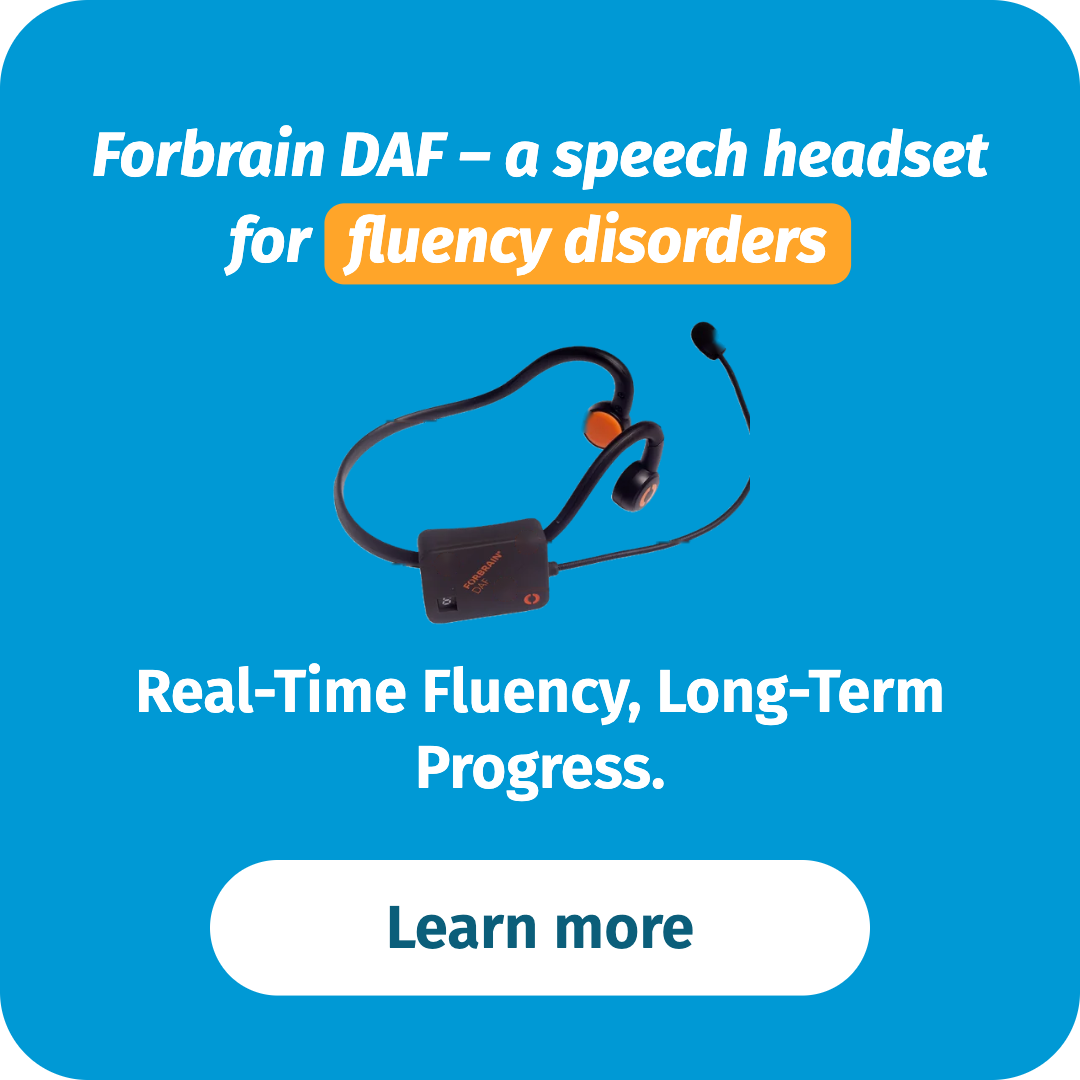
Forbrain is an auditory stimulation tool that can be used to support fluency. Forbrain is a headset that uses delayed auditory feedback to present your own voice back to you at a slight delay. This may lead to smoother and more controlled speech. Forbrain for stuttering is designed to support fluency not just in the moment it is worn, but over time. A single-case study found that Forbrain may modify speech patterns in individuals who stutter. Forbrain should be used as a support alongside professional therapy, not as a treatment or cure. It should not replace professional evaluation or therapy when concerns are significant.
Bottom Line
If you are concerned that you or your child stutters, it can be difficult to know where to begin. Knowing the types of stuttering and how it shows up in speech can help you have a better idea of what kind of stuttering you or your child exhibits. If you have concerns, take the next step and schedule an evaluation with a licensed speech-language pathologist. They can help you narrow down the type of stuttering you or your child has, which helps guide appropriate support and treatment.
References
American Institute for Stuttering. (2020, April 30). Understanding developmental stuttering: A stuttering-affirming perspective. https://www.stutteringtreatment.org/blog/understanding-developmental-stuttering
American Speech-Language-Hearing Association. (n.d.). Stuttering, cluttering, and fluency. Retrieved November 6, 2026, from https://www.asha.org/practice-portal/clinical-topics/fluency-disorders/
Escera, C., Gorina-Careta, N., & López-Caballero, F. (2018). The potential use of Forbrain® in stuttering: A single-case study. Anuario de Psicología, 48(2), 51-58.
Mahr, G. & Leith, W. (1992). Psychogenic stuttering of adult onset. Journal of Speech, Language, and Hearing Research, 35(2), 283-286. https://doi.org/10.1044/jshr.3502.283
National Stuttering Association. (n.d.). Neurogenic vs developmental stuttering: key difference. Retrieved November 6, 2026, from https://www.westutter.org/post/neurogenic-vs-developmental-stuttering
Stop Stutter. (2026, September 8). Prolongations in stuttering: what they are, real examples, and what helps. Stop Stutter. https://www.stopstutter.org/blogs/prolongations-in-stuttering
The Stuttering Foundation. (n.d.). Neurogenic stuttering. Retrieved November 8, 2026 from https://www.stutteringhelp.org/neurogenic-stuttering
Treleaven, S., Rubsam, S., Sheppard, M., Yaruss, J. S., & Chang, S. (2025, May 8). Assessing childhood stuttering recovery: incorporating self-identification and caregiver/clinician reports through adolescence. Journal of Speech, Language, and Hearing Research, 68(5), 2218-2235. https://doi.org/10.1044/2025_JSLHR-24-00501